
Footprints of the Gods: Extra Digits—The Mark of the Giants by Jim Vieira and Greg Maestro explores the recurring appearance of six-fingered and six-toed figures across ancient civilizations, archaeological artifacts, religious texts, and historical traditions.Drawing on material from Mesopotamia, the ancient Near East, Jordan, Iran, North America, and other regions, the book examines whether these unusual depictions reflect symbolic art, real cases of polydactyly, or cultural traditions connected to rulers, heroes, and divine figures. The authors also discuss references from texts such as the Epic of Gilgamesh, the Book of Enoch, and biblical passages.Rather than promoting a single theory, Vieira and Maestro present a broad collection of archaeological and historical evidence and invite readers to consider why similar motifs appear across distant cultures. The book aims to encourage further discussion and research into the relationship between archaeology, mythology, physical characteristics, and ancient belief systems.Footprints of the Gods: Extra Digits—The Mark of the Giants is now available on Amazon.
New York, New York, United States, 12th Aug 2026 – For centuries, archaeologists, historians, and readers of ancient literature have examined artifacts, inscriptions, and traditions that raise questions about humanity’s distant past. A newly released book, Footprints of the Gods: Extra Digits—The Mark of the Giants, by Jim Vieira and Greg Maestro, brings together archaeological discoveries, historical records, and ancient narratives to examine one recurring detail found across multiple civilizations: the depiction of individuals with six fingers and six toes.
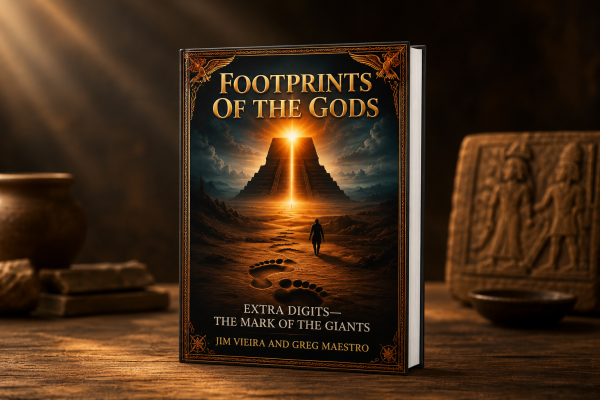
Rather than presenting a single conclusion, the book surveys evidence drawn from Mesopotamia, the ancient Near East and many more spanning nine regions where unusual anatomical features appear in sculptures, seals, religious imagery, and historical texts. The authors explore whether these recurring depictions were symbolic artistic choices, representations of real individuals with polydactyly, or part of broader traditions surrounding rulers, heroes, and divine beings.
Among the artifacts discussed are Mesopotamian cylinder seals, ancient amulets, stone sculptures, and archaeological finds that depict figures with extra digits. The research also examines references from ancient literature, including the Epic of Gilgamesh and the Book of Enoch, alongside religious passages that mention individuals described as having six fingers and six toes.
The publication highlights how similar motifs appear across geographically distant cultures, prompting questions about whether these parallels developed independently or reflect shared traditions that spread over time. Rather than focusing on sensational claims, the authors encourage readers to examine the available evidence and consider how archaeology, mythology, and written history sometimes intersect in unexpected ways.
In addition to discussing well-known archaeological sites in Mesopotamia, the book references discoveries from Jordan, Iran, and North America, where images and carvings featuring extra digits have also been documented. By comparing these findings, the authors seek to identify recurring patterns that have received relatively little attention in mainstream discussions of ancient history.
The work also explores how ancient societies associated physical characteristics with status, ancestry, and religious significance. Throughout history, unusual anatomical traits have often been interpreted differently depending on cultural context, sometimes serving as symbols of authority, divinity, or distinction.
According to the authors, the purpose of the book is not to rewrite history but to encourage closer examination of archaeological evidence and historical sources that continue to generate scholarly and public interest. By assembling material from multiple civilizations into a single volume, the book invites readers to consider whether recurring details preserved in artifacts and texts may warrant further research.
As public interest in ancient civilizations, archaeology, and historical mysteries continues to grow, Footprints of the Gods: Extra Digits—The Mark of the Giants contributes to the ongoing conversation by presenting a broad collection of historical references, archaeological discoveries, and visual evidence related to one of antiquity’s more unusual recurring themes.
The book is now available on Amazon.
About the Authors
Jim Vieira. Vieira has spent years researching reports and traditions involving giants, flood narratives, and polydactyly in ancient art and archaeology. His research has included travel to archaeological sites in the Andes, Malta, Turkey, Mexico, and Peru, as well as conversations with tribal elders, museum curators, and archaeologists.
Greg Maestro. Maestro brings a background in biblical and esoteric literature, travel, filmmaking, and technical research. His collaboration with Vieira grew from a shared interest in questions surrounding humanity’s ancient origins, and he contributed to expanding the book’s documented cases, research scope, and narrative structure.
Media Contact
Organization: USA Publishing Hub
Contact Person: Steve Harper
Website: https://usapublishinghub.com/
Email: Send Email
Contact Number: +12677145850
Address:353 Lexington Avenue
Address 2: 6th Floor Suite #603-PMB
City: New York
State: New York
Country:United States
Release id:48048
The post Ancient Texts, Modern Questions: New Book Explores the Recurring Mystery of Polydactyly Throughout History appeared first on King Newswire. This content is provided by a third-party source.. King Newswire makes no warranties or representations in connection with it. King Newswire is a press release distribution agency and does not endorse or verify the claims made in this release. If you have any complaints or copyright concerns related to this article, please contact the company listed in the ‘Media Contact’ section
Disclaimer: The views, suggestions, and opinions expressed here are the sole responsibility of the experts. No Current Hue journalist was involved in the writing and production of this article.